 5d88c52e30
* Initial support for Hand Raise feature

Signed-off-by: Milton Moura <miltonmoura@gmail.com>

* Refactored to use reaction and redaction events

Signed-off-by: Milton Moura <miltonmoura@gmail.com>

* Replacing button svg with raised hand emoji

Signed-off-by: Milton Moura <miltonmoura@gmail.com>

* SpotlightTile should not duplicate the raised hand

Signed-off-by: Milton Moura <miltonmoura@gmail.com>

* Update src/room/useRaisedHands.tsx

Element Call recently changed to AGPL-3.0

* Use relations to load existing reactions when joining the call

Signed-off-by: Milton Moura <miltonmoura@gmail.com>

* Links to sha commit of matrix-js-sdk that exposes the call membership event id and refactors some async code

Signed-off-by: Milton Moura <miltonmoura@gmail.com>

* Removing RaiseHand.svg

* Check for reaction & redaction capabilities in widget mode

Signed-off-by: Milton Moura <miltonmoura@gmail.com>

* Fix failing GridTile test

Signed-off-by: Milton Moura <miltonmoura@gmail.com>

* Center align hand raise.

* Add support for displaying the duration of a raised hand.

* Add a sound for when a hand is raised.

* Refactor raised hand indicator and add tests.

* lint

* Refactor into own files.

* Redact the right thing.

* Tidy up useEffect

* Lint tests

* Remove extra layer

* Add better sound. (woosh)

* Add a small mode for spotlight

* Fix timestamp calculation on relaod.

* Fix call border resizing video

* lint

* Fix and update tests

* Allow timer to be configurable.

* Add preferences tab for choosing to enable timer.

* Drop border from raised hand icon

* Handle cases when a new member event happens.

* Prevent infinite loop

* Major refactor to support various state problems.

* Tidy up and finish test rewrites

* Add some explanation comments.

* Even more comments.

* Use proper duration formatter

* Remove rerender

* Fix redactions not working because they pick up events in transit.

* More tidying

* Use deferred value

* linting

* Add tests for cases where we got a reaction from someone else.

* Be even less brittle.

* Transpose border to GridTile.

* First PoC for reactions

* hide menu by default

* Add lightbulb.

* Add reaction indicator.

* Add sounds.

* Tidy up + add support for floating emoji.

* Linting and general stability improvements.

* Subscribe to the ecall reaction event type.

* fix import

* Center emoji picker

* Overflow buttons when screen is too narrow

* lint

* Add settings for disabling animations / sounds.

* Make vertical divider more visually distinct.

* Make event listener more resillient.

* lint

* Fix some tests.

* Remove old raised hand component

* Add new icon

* Update text

* Update compound hand raised icon.

* Add deer.

* Fix case where you could send larger strings as emoji

* Const the active time.

* Document time in css.

* Add rock emoji

* Add licence file.

* Add type def for custom reaction type.

* better reaction description

* Factor out reactions test structure to utils file.

* Add tests for ReactionToggleButton

* Add keyboard shortcuts for reaction sending.

* type tidyups

* lint

* Add tests for ReactionAudioRenderer

* lint

* prettier

* i18n sort

* final lint?

* Preload reaction sounds to prevent delays.

* Update rock sounds

* add onclick back

* Fix test

* lint

* simplify

* Tweak line height

* modal impl

* Modal refactor attempts.

* Remove closed menu test since we're using Modal.

* Swap icon, make mobile view better.

* Fix mobile view for emoji picker.

* Use Intl.Segmenter

* Clear timeouts on component close.

* Remove useless useCallback

* Use prefers-reduced-motion

* Add toggle for raise hand.

* Add lower hand text

* Add lower motion mode.

* Decomplicate className system for Modal

* Add error for failured to send reaction.

* i18n

* Spacing for emoji buttons search

* Remove unrequired media query

* Fix generic sound not playing.

* Clear reactions if we're clearing timeouts.

* Fix tests

* Relabel lower hand

* More translations

* Add comments on reaction interface

* Move polyfill.

* lint

* Replace deer sound

* Another attempt to fix the sizing of the reactions

* cleanup

* fix button

* fix

---------

Signed-off-by: Milton Moura <miltonmoura@gmail.com>
Co-authored-by: Milton Moura <miltonmoura@gmail.com>
Co-authored-by: fkwp <fkwp@users.noreply.github.com>
Element Call


Group calls with WebRTC that leverage Matrix and an open-source WebRTC toolkit from LiveKit.
For prior version of the Element Call that relied solely on full-mesh logic,
check full-mesh
branch.

To try it out, visit our hosted version at call.element.io. You can also find the latest development version continuously deployed to call.element.dev.
Host it yourself
Until prebuilt tarballs are available, you'll need to build Element Call from source. First, clone and install the package:
git clone https://github.com/element-hq/element-call.git
cd element-call
yarn
yarn build
If all went well, you can now find the build output under dist as a series of
static files. These can be hosted using any web server that can be configured
with custom routes (see below).
You may also wish to add a configuration file (Element Call uses the domain it's
hosted on as a Homeserver URL by default, but you can change this in the config
file). This goes in public/config.json - you can use the sample as a starting
point:
cp config/config.sample.json public/config.json
# edit public/config.json
Because Element Call uses client-side routing, your server must be able to route
any requests to non-existing paths back to /index.html. For example, in Nginx
you can achieve this with the try_files directive:
server {
    ...
    location / {
        ...
        try_files $uri /$uri /index.html;
    }
}
By default, the app expects you to have a Matrix homeserver (such as Synapse) installed locally and running on port 8008. If you wish to use a homeserver on a different URL or one that is hosted on a different server, you can add a config file as above, and include the homeserver URL that you'd like to use.
Element Call requires a homeserver with registration enabled without any 3pid or token requirements, if you want it to be used by unregistered users. Furthermore, it is not recommended to use it with an existing homeserver where user accounts have joined normal rooms, as it may not be able to handle those yet and it may behave unreliably.
Therefore, to use a self-hosted homeserver, this is recommended to be a new server where any user account created has not joined any normal rooms anywhere in the Matrix federated network. The homeserver used can be setup to disable federation, so as to prevent spam registrations (if you keep registrations open) and to ensure Element Call continues to work in case any user decides to log in to their Element Call account using the standard Element app and joins normal rooms that Element Call cannot handle.
Configuration
There are currently two different config files. .env holds variables that are
used at build time, while public/config.json holds variables that are used at
runtime. Documentation and default values for public/config.json can be found
in ConfigOptions.ts.
If you're using Synapse, you'll need
to additionally add the following to homeserver.yaml or Element Call won't
work:
experimental_features:
    # MSC3266: Room summary API. Used for knocking over federation
    msc3266_enabled: true

# The maximum allowed duration by which sent events can be delayed, as
# per MSC4140.
max_event_delay_duration: 24h

rc_message:
  # This needs to match at least the heart-beat frequency plus a bit of headroom
  # Currently the heart-beat is every 5 seconds which translates into a rate of 0.2s
  per_second: 0.5
  burst_count: 30
MSC3266 allows to request a room summary of rooms you are not joined. The summary contains the room join rules. We need that to decide if the user gets prompted with the option to knock ("ask to join"), a cannot join error or the join view.
Element Call requires a Livekit SFU alongside a Livekit JWT
service to work. The url to the
Livekit JWT service can either be configured in the config of Element Call
(fallback/legacy configuration) or be configured by your homeserver via the
.well-known/matrix/client. This is the recommended method.
The configuration is a list of Foci configs:
"org.matrix.msc4143.rtc_foci": [
    {
        "type": "livekit",
        "livekit_service_url": "https://someurl.com"
    },
     {
        "type": "livekit",
        "livekit_service_url": "https://livekit2.com"
    },
    {
        "type": "another_foci",
        "props_for_another_foci": "val"
    },
]
Translation
If you'd like to help translate Element Call, head over to Localazy. You're also encouraged to join the Element Translators space to discuss and coordinate translation efforts.
Development
Frontend
Element Call is built against matrix-js-sdk. To get started, clone, install, and link the package:
git clone https://github.com/matrix-org/matrix-js-sdk.git
cd matrix-js-sdk
yarn
yarn link
Next, we can set up this project:
git clone https://github.com/element-hq/element-call.git
cd element-call
yarn
yarn link matrix-js-sdk
To use it, create a local config by, e.g., cp ./config/config.devenv.json ./public/config.json and adapt it if necessary. The config.devenv.json config
should work with the backend development environment as outlined in the next
section out of box.
(Be aware, that this config.devenv.json is exposing a deprecated fallback
LiveKit config key. If the homeserver advertises SFU backend via
.well-known/matrix/client this has precedence.)
You're now ready to launch the development server:
yarn dev
Backend
A docker compose file dev-backend-docker-compose.yml is provided to start the
whole stack of components which is required for a local development environment:
- Minimum Synapse Setup (servername: synapse.localhost)
- LiveKit JWT Service (Note requires Federation API and hence a TLS reverse proxy)
- Minimum TLS reverse proxy (servername: synapse.localhost) Note certificates are valid for at least 10 years from now
- Minimum LiveKit SFU Setup using dev defaults for config
- Redis db for completness
These use a test 'secret' published in this repository, so this must be used only for local development and never be exposed to the public Internet.
Run backend components:
yarn backend
# or  for podman-compose
# podman-compose -f dev-backend-docker-compose.yml up
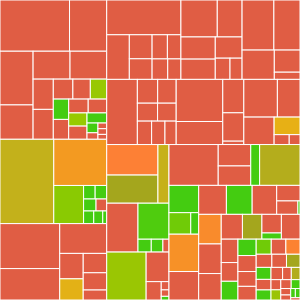
Test Coverage
Add a new translation key
To add a new translation key you can do these steps:
- Add the new key entry to the code where the new key is used:
t("some_new_key") - Run
yarn i18nto extract the new key and update the translation files. This will add a skeleton entry to thepublic/locales/en-GB/app.jsonfile:{ ... "some_new_key": "", ... } - Update the skeleton entry in the
public/locales/en-GB/app.jsonfile with the English translation:
   {
       ...
       "some_new_key": "Some new key",
       ...
   }
Documentation
Usage and other technical details about the project can be found here: